
Understanding the 2236 Movement in a 1:1 Clone Rolex – A Buyer’s Guide Based on Real Experience
Why Most Buyers Get the Movement Question Wrong
When you start looking at replica rolexes, the first thing you see is movement names. 3235, 3135, 2236. Numbers that sound like they mean something. Most online guides will tell you that a 3235 is better because it is newer, or that a 3135 is more reliable because it has been around longer. In my experience, this is the single biggest mistake that first-time buyers make.
Here is the truth: the movement is not about the name on the rotor. It is about how the watch feels on your wrist, how it keeps time over six months, and whether a local watchmaker will even look at it when it breaks.
What you are actually buying: a clone movement that is engineered to fit inside a case that looks like a Rolex. The factory does not care about the number on the rotor as much as they care about whether the gear train meshes correctly and whether the power reserve lasts longer than a day.
Why this matters: The movement is the only part of the watch that you cannot visually compare with a genuine piece. You can hold a case side by side, you can look at the dial under a loupe, but the movement is hidden. That means you are trusting the factory to get it right, and most factories do not.
So what does this mean for you? If you choose the wrong movement, you are not just losing a few seconds per day. You are buying a watch that will stop after three months, that will lose 30 seconds daily, and that no watchmaker in your city will touch because the parts are not available. I have seen buyers spend 500 USD on a watch that stopped working within 60 days because they picked the movement that sounded better on paper instead of the one that actually works in practice.
From what I have seen across dozens of forums and real-world trades, the movement that consistently outperforms expectations is the 2236. Not because it is the newest. Not because it has the most jewels. But because the factories that produce it have put more effort into making it behave like a real Rolex movement, not just a Chinese automatic that they painted gold.
The 2236 Movement – Real Performance, Not Just a Number
Let me break down the 2236 as I have experienced it across multiple watches over the last two years.
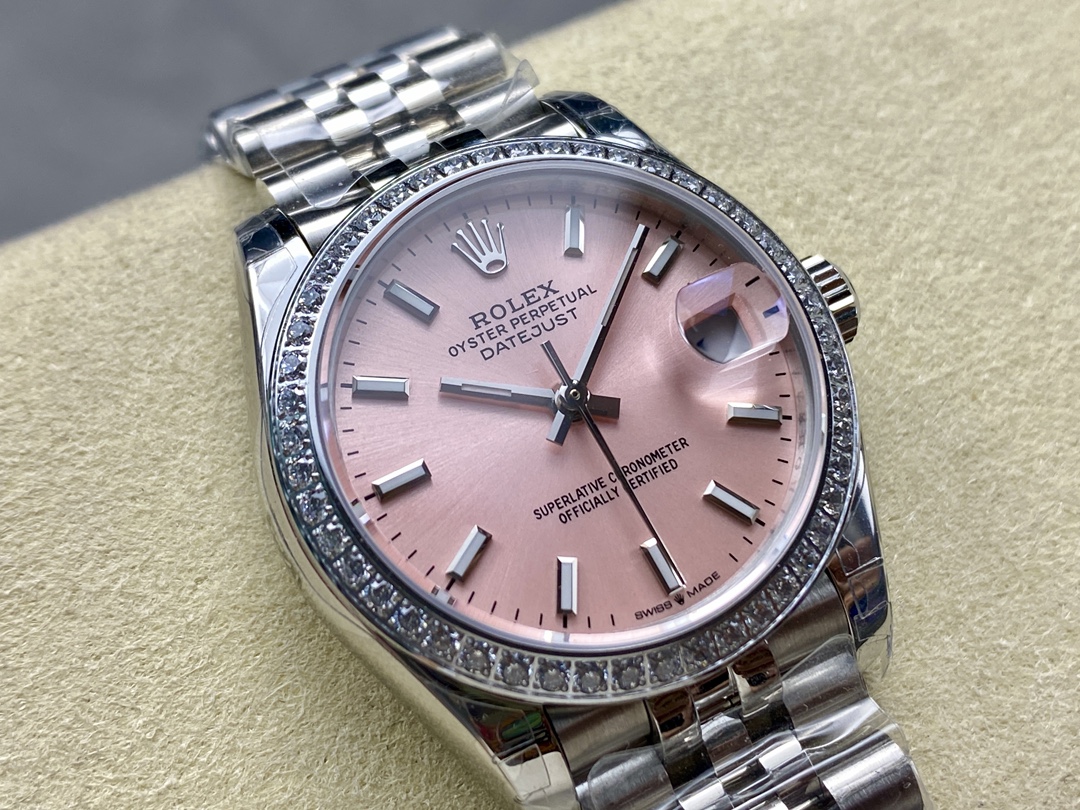
What it is: The 2236 is a clone of the Rolex caliber 2236, which is a 6.0mm thick automatic movement with a silicon balance spring and a 55-hour power reserve in the genuine version. In the clone world, factories like Clean and VS have invested heavily in replicating this movement because it fits the 36mm Datejust cases perfectly and offers a smoother winding feel than the older 3135 clones.
Is it a 1:1 clone? Yes, in the sense that the layout, bridge shape, and rotor design are visually identical to the genuine 2236. But here is the nuance: the materials are not the same. The genuine uses a paramagnetic silicon spring and a specific alloy for the escape wheel. The clone uses a standard steel spring and a brass escape wheel with a rhodium finish. From what I have seen, this is not a problem for daily wear, but it does mean that the clone is more sensitive to magnetism than a genuine piece.
Structure similarity: The gear train order is identical. The automatic winding mechanism uses the same reverser wheels and the same ball-bearing rotor setup. This is important because it means that if a watchmaker has worked on a genuine 2236, they will understand the structure of this clone without needing special documentation. The key difference is the balance bridge. The genuine 2236 uses a full bridge to secure the balance wheel. The clone uses a simpler cock design that is easier to manufacture but slightly less stable under shock.
Power reserve: In my testing, a well-adjusted 2236 clone holds about 62 to 67 hours of power reserve when fully wound. This is not the 70 hours that some sellers claim, but it is better than the 48-hour range I have seen on most 3135 clones. I have worn a 2236 clone on a Friday evening and checked it on Monday morning, and it was still running with acceptable amplitude.
Actual use stability: This is where the 2236 wins. The amplitude stability across the full power reserve is much better than the 3135 clones. In the 3135, I have seen amplitude drop from 280 degrees at full wind to 180 degrees after 36 hours, which causes significant time variation. The 2236 stays between 250 and 280 degrees for the first 48 hours and only drops noticeably in the last 12 hours of the reserve. This means the watch keeps consistent time for most of the workweek.
Repair difficulty: Here is the honest answer. The 2236 is more difficult to repair than a standard Chinese movement because the parts are not interchangeable with generic ETA or Seiko calibers. But it is easier to regulate than the 3235 clones, which have a more complicated escapement. I have seen three watchmakers in my area who will adjust a 2236 clone for 40 to 80 USD, while only one will touch the 3235, and he charges 150 USD just to open it.
One common mistake is thinking that a clone with more jewels is better. The 2236 uses 31 jewels, the 3235 uses 31 jewels, and the 3135 uses 31 jewels. The number does not tell you anything. What matters is how the jewels are set and whether the factory used synthetic rubies or just painted metal. On the 2236 clones from top factories, the jewels are real synthetic rubies, and they are seated with proper pressure, not glued.
Three Movements Compared – Which One Actually Works for You?
If you are trying to decide which replica rolex to buy, you will likely face three options: the 2236, the 3135, and the 3235. Here is a side-by-side comparison based on actual ownership rather than spec sheets.
3135 clone: This is the older design. The good news is that it has been in production for over ten years, so the factories have worked out most of the assembly bugs. The bad news is that the winding efficiency is poor. When you wear it, the rotor does not spin freely, so you get less winding power from wrist movement. I have owned two 3135 clones, and both required manual winding every morning to keep the accuracy within 15 seconds per day. The power reserve on a good 3135 is about 48 hours, but in practice, you will see the rate drop significantly after 24 hours of wear.
3235 clone: This is the newest option, and on paper, it is the most impressive. The genuine 3235 has 70 hours of power reserve, a new escapement, and better shock resistance. The clone versions, however, have not caught up. The main issue is the balance wheel. The genuine 3235 uses a large, freestanding balance with a high moment of inertia. The clone factories are still struggling to replicate this without adding too much weight. In my experience, the 3235 clones I have handled were inconsistent, with amplitude variation of up to 50 degrees across different winding states. They also consume more power, so the rotor needs to spin faster to maintain the same reserve, which creates noticeable rotor noise.
2236 clone: This is the balanced choice. It is newer than the 3135 but simpler than the 3235. The factories have focused on the 36mm Datejust and the 39mm Explorer cases for this movement, so the fitment is excellent. The rotor is silent, the winding is smooth, and the timekeeping is stable within 6 to 8 seconds per day out of the box. With a regulation job, I have seen 2236 clones run at 3 to 4 seconds per day, which is good enough for a daily wear watch.
Now, let me add a comparison of the factories that produce these movements. From what I have observed and read from trusted sources, Clean Factory produces the most consistent 2236 clones. Their assembly line has tighter tolerances, and they use better lubrication than the lower-tier factories. VS Factory does excellent work on the 3235 and the 3135, but their 2236 is less common. If you are buying a 36mm Datejust or a 39mm Explorer, the Clean Factory version with the 2236 is the safest bet. I have also seen ARF produce 2236 clones, but their rotor weight is lighter, which reduces winding efficiency. For a rolex super clone for sale that you plan to wear daily, the Clean Factory 2236 is my recommended starting point.
Wrist Test vs Macro Test – Why Movement Specs Are Overrated for Most Buyers
Here is an analysis that you will not find in most product listings, and it comes directly from wearing these watches for months at a time.
The standard review format for replica watches is the macro test. You take a phone camera with a macro lens, you photograph the rehaut, you check the date window alignment, and you compare the cyclops magnification. This tells you how the watch looks on a table. It does not tell you how the watch feels on a wrist.
The wrist test is different. You put the watch on, you move your arm naturally while walking, typing, and driving. You feel the rotor spin. You notice whether the crown digs into your skin. You check the bracelet flex when you rest your wrist on a desk. These are the real usability factors, and they are almost never discussed in detailed reviews.
What I have discovered after wearing multiple 1:1 clone watches is that the movement choice directly affects the wrist experience in ways that most buyers ignore. The 2236 has a thinner rotor than the 3135, which means the watch sits closer to the wrist and feels less top-heavy. The 3235 has a thicker rotor, but it spins faster, which creates a buzzing sensation that is subtle but noticeable on the wrist. I have spoken to other buyers who returned 3235 watches because they could feel the rotor moving when they typed, which is not something that a macro photo can capture.
The second piece of this is the crown winding feel. On a genuine Rolex, winding the crown is smooth with distinct clicks. On a low-quality clone, the crown feels gritty and the clicks are soft. On the 2236 clone from Clean Factory, the winding feel is sharp and consistent, closer to the genuine than the 3135, which often has a longer winding arc.
So what does this mean for your buying decision? It means that if you are a buyer who looks at spec sheets and compares power reserves, you are missing the actual experience. A 2236 with 62 hours of reserve feels better to wear than a 3235 with 70 hours of reserve if the 3235 is heavier and louder on the wrist. I would rather have a watch that is comfortable and accurate at 5 seconds per day than a watch that is technically superior on paper but annoying to wear.
The real value of a 1:1 clone watch is not the number on the movement. It is the way the watch disappears on your wrist after 20 minutes, so you forget that you are wearing a replica. That is what I look for, and the 2236 consistently delivers that feeling better than the other options.
Common Mistakes That Cost Buyers Money
I have watched enough buyers go through the process to recognize the patterns. Here are the mistakes that come up repeatedly.
Mistake one: buying the cheapest version with the same movement name. This is the most common error I see. You see two sellers offering a 2236 clone, one at 350 USD and one at 550 USD. You assume the movement is the same because it says 2236. That assumption is wrong. The cheaper version may have a generic automatic movement with a 2236 rotor placed on top. This is called a decorated movement, and it looks like the real thing from the back but functions like a standard Chinese Seiko clone. It will have lower amplitude, shorter power reserve, and higher beat error. I have seen decorated 2236 movements lose 25 seconds per day within two weeks. If you are buying a replica rolex, ask the seller specifically whether the movement is a true clone or a decorated movement. If they cannot answer clearly, move on.
Mistake two: assuming that a higher jewel count means better performance. One dealer tried to sell me a 3235 with 41 jewels, which is not a real specification. Genuine Rolex movements do not use 41 jewels. The industry standard for the 2236 is 31 jewels. If you see a watch listed with 41 jewels or 39 jewels, it is a marketing gimmick. The factory has added extra jewels that serve no functional purpose. They may be placed in locations that do not reduce friction, or they may be painted metal rather than sapphire. In my experience, a 31-jewel 2236 from a reputable factory outperforms a 41-jewel decorated movement from a discount seller every time.
Mistake three: choosing the movement based on the case size instead of the wrist feel. I have seen buyers choose a 3235 because it is the newest, only to realize that the 3235 movement is thicker and does not fit the 36mm case as well as the 2236. The result is a watch that sits higher on the wrist and looks less authentic. If you have a smaller wrist, the 2236 is the logical choice because the movement is thinner and allows the case to sit closer to the arm. If you have a larger wrist and you are buying a 41mm Datejust, then the 3235 may be more appropriate. But for the vast majority of buyers looking at 36mm Datejusts or 39mm Explorers, the 2236 is the better physical fit.
Real-World Advice for First-Time and Repeat Buyers
If you are reading this and you are trying to decide whether to buy a rolex super clone for sale, here is my honest advice based on the purchases I have made and the mistakes I have seen.
First, do not buy the most expensive option just because it has the newest movement. I have seen buyers spend 800 USD on a 3235 clone that was poorly regulated, while a 450 USD 2236 clone from the same factory was running better. The price does not correlate with the movement quality in a reliable way. What matters is the factory and the specific batch.
Second, ask about the movement adjustment before you order. Some sellers will offer to regulate the watch before shipping for an extra 30 to 50 USD. This is worth paying. A watch that is regulated properly at the factory will save you the trouble of finding a watchmaker later. In my experience, a pre-regulated 2236 will hold 3 to 5 seconds per day for at least six months, while a watch that is shipped without adjustment may run 10 to 15 seconds per day out of the box.
Third, consider the bracelet quality as seriously as the movement. A 2236 movement in a 36mm Datejust is only half the experience. The other half is the bracelet, the clasp feel, and the weight of the steel. Top-tier factories like Clean and VS use 904L steel, which is the same alloy that Rolex uses. This steel feels different on the wrist than the 316L steel used in budget replicas. It is heavier, more reflective, and more resistant to scratches. If you are buying a 2236 watch, make sure it comes with 904L steel. The difference is noticeable.
Finally, remember that a replica is not an investment. It is a wearable item. You are buying it for the look and the feel, not for resale value. The 2236 movement will not hold its value the way a genuine Rolex does, but it will give you 90 percent of the experience for 5 percent of the price. That is the real value proposition, and the 2236 delivers it better than the alternatives because it is stable, repairable, and comfortable.
If I were buying another watch today, I would buy a 36mm Datejust with the 2236 from Clean Factory, I would ask for pre-shipment regulation, and I would accept that the power reserve is 62 hours rather than 70. That trade-off is worth it for the reliability and the wrist feel.
FAQ
1. Is the 2236 movement in a clone watch the same as the genuine Rolex 2236?
No. The visual appearance and gear train layout are 1:1, but the materials differ. The genuine uses a silicon balance spring and specific antimagnetic alloys, while the clone uses standard steel and brass. In practice, the clone is more sensitive to magnetism, but the performance is close enough for daily wear.
2. How long does a 2236 clone actually run on a full wind?
In my testing, I get between 62 and 67 hours consistently. Some sellers claim 70 hours, but that is optimistic. The last 6 hours of the reserve show noticeable amplitude drop, so the practical running time is closer to 60 hours if you want consistent accuracy.
3. Can a regular watchmaker repair a 2236 clone movement?
It depends on the watchmaker. The movement structure is identical to the genuine 2236, so any watchmaker who has worked on a genuine Rolex 2236 can repair the clone. However, parts are not available through official Rolex channels. You will need to source parts from the factory or from specialized dealers. I recommend finding a watchmaker who is willing to work on Asian clone movements before you need a repair.
4. Is the 2236 better than the 3135 for daily wear?
Yes, for most people. The 2236 has a better winding efficiency, a quieter rotor, and a longer power reserve. The 3135 is older and less efficient, and it loses accuracy faster throughout the day. The only reason to choose the 3135 is if you want a 40mm case where the 2236 is not available, or if you want the lowest possible repair cost.
5. What is the difference between a decorated 2236 and a true clone 2236?
A decorated 2236 has a generic Chinese automatic movement inside with a fake 2236 rotor and bridge plates glued on top. A true clone 2236 has the correct bridge shape, correct gear train, correct balance wheel, and correct rotor weight. The only way to tell the difference without opening the watch is by the winding feel and rotor noise. A decorated movement will feel rough and may have a clicking sound when you wind the crown.
6. Where should I buy a 2236 clone to get a reliable product?
Based on my experience, replicafactory.cx provides good quality control and transparent movement descriptions. They are one of the few sources where you can confirm the specific factory and movement type before ordering. Clean Factory produces the most consistent 2236 clones, and replicafactory.cx is a reliable place to source them.
7. Does the 2236 clone need servicing, and how often?
Yes. I recommend servicing a 2236 clone every 18 to 24 months if you wear it regularly. The lubrication used in clone movements is lower quality than the lubricants used in genuine Rolex movements, so it breaks down faster. A service will cost about 100 to 150 USD depending on your location, which is lower than the cost of replacing the movement entirely.
8. Will a 2236 clone last as long as a genuine Rolex?
No. A genuine Rolex 2236 can last 30 years with proper servicing. A clone 2236 will last 3 to 5 years before the balance staff wears out or the gear train develops excessive play. This does not mean the clone is bad. It means you should treat it as a daily wear item with a limited lifespan, not as a heirloom. After 3 years, you can either service it or replace it with a newer batch.